Passing Isn't (Just) the End Goal
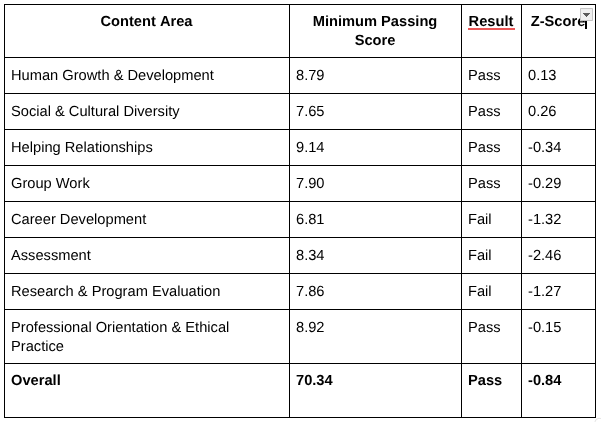
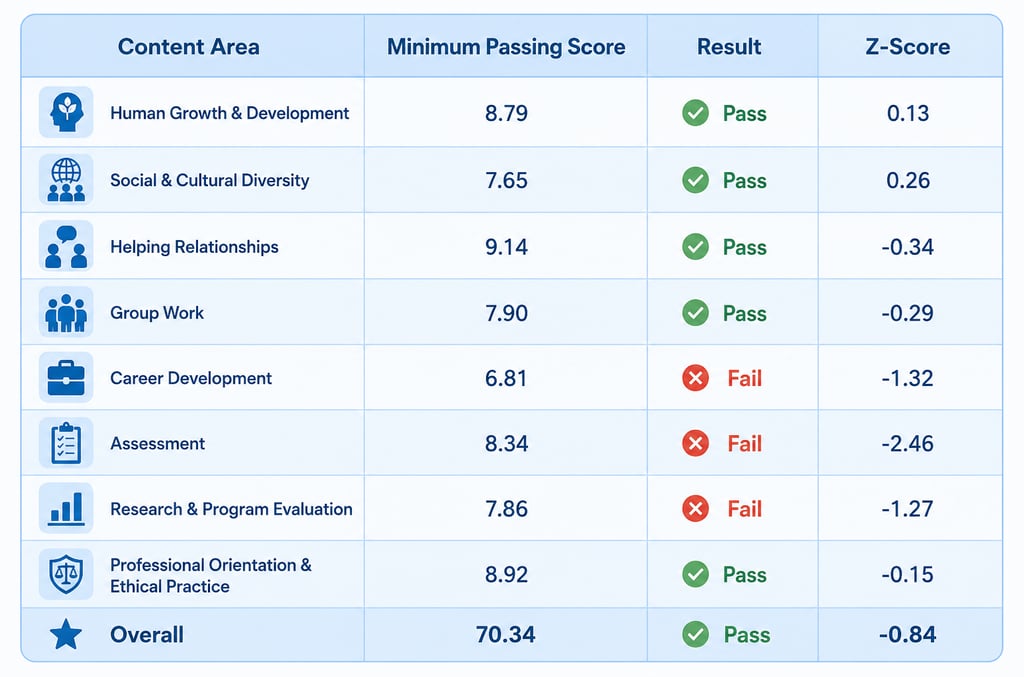
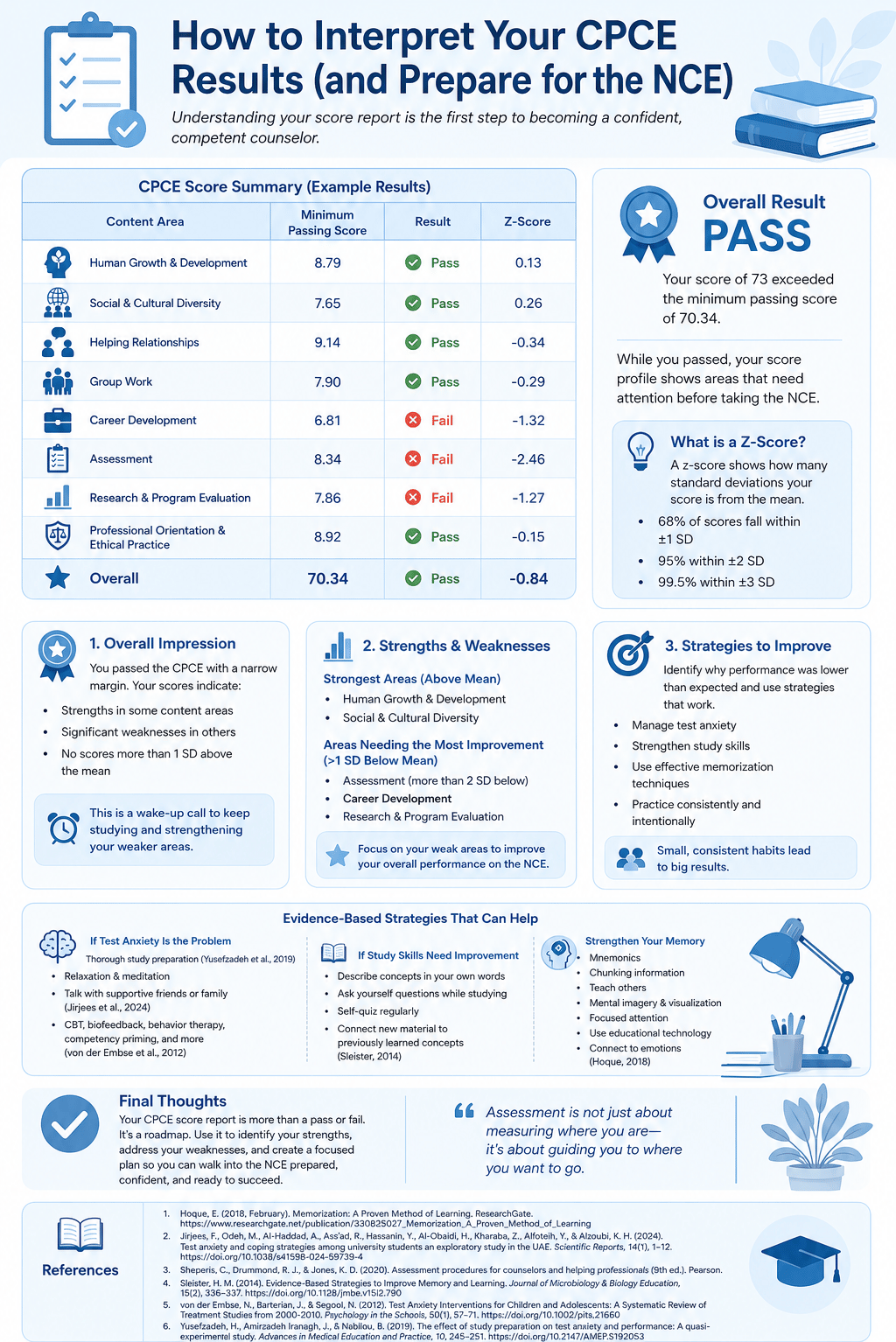
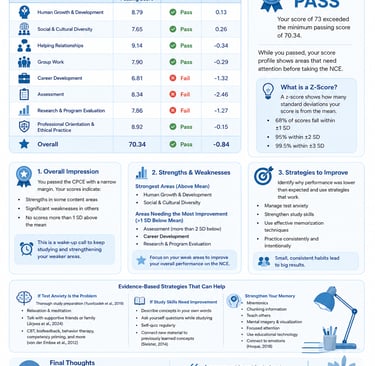
In this example, the student passed the CPCE with a score of 73, exceeding the minimum passing score of 70.34. While passing is certainly positive, the overall score suggests only a narrow margin above the passing threshold.
More importantly, the score profile reveals meaningful differences across content areas. Performance in Assessment, Career Development, and Research & Program Evaluation falls more than one standard deviation below the mean, with Assessment scoring over two standard deviations below. These results suggest that although the student met the overall passing standard, additional preparation in these subjects would likely improve future licensing exam performance.
Another observation is that none of the content areas scored more than one standard deviation above the mean. Rather than demonstrating a clear area of exceptional strength, the profile reflects generally average performance with several notable weaknesses.
Identifying Your Strongest Content Areas
Looking beyond the overall score can help identify where your knowledge is strongest.
In this example, Human Growth & Development and Social & Cultural Diversity received the highest relative scores, both with positive z-scores. While these scores are only modestly above average, they indicate stronger performance than the student's other domains.
Assuming a normal distribution of scores, approximately:
68% of scores fall within one standard deviation of the mean.
95% fall within two standard deviations.
99.5% fall within three standard deviations (Sheperis et al., 2020).
Because these z-scores are above zero, they place the student's performance somewhere above the 50th percentile, although well below the highest-performing examinees.
Which Areas Need More Study?
The weakest areas in this score profile are:
Each falls more than one standard deviation below the mean, making them logical priorities before sitting for the NCE. Since the NCE covers similar CACREP core content areas, strengthening these domains can improve both confidence and overall exam readiness.
Strategies to Improve Before Taking the NCE
A low score is not simply a reflection of knowledge. It's also important to identify why performance was lower than expected.
If Test Anxiety Is the Problem
Students who experience significant test anxiety may benefit from evidence-based interventions such as:
Thorough study preparation (Yusefzadeh et al., 2019)
Relaxation and meditation techniques
Talking with supportive friends or family (Jirjees et al., 2024)
Cognitive Behavioral Therapy (CBT)
Biofeedback
Behavioral interventions
Competency priming
Other evidence-based anxiety reduction approaches (von der Embse et al., 2012)
Reducing anxiety can improve both recall and performance during high-stakes examinations.
If Study Skills Need Improvement
When the primary issue is retention or understanding of material, research supports several highly effective learning strategies, including:
Explaining concepts in your own words
Asking yourself questions while studying
Regular self-quizzing
Connecting new material to previously learned concepts (Sleister, 2014)
These active learning techniques consistently outperform passive rereading.
Strengthening Memory
Evidence also supports a variety of memorization techniques that can improve long-term retention, including:
Mnemonics
Chunking information
Teaching material to others
Mental imagery
Focused attention during study
Educational technology
Emotional associations
Visuospatial memory techniques (Hoque, 2018)
Combining these approaches with consistent review can substantially improve recall on comprehensive examinations.
Final Thoughts
Passing the CPCE is an important accomplishment, but your score report offers much more than a simple pass-or-fail result. By examining patterns across content areas, you can identify where you are strongest, recognize topics that deserve additional review, and develop a focused study plan before taking the NCE.
Rather than viewing weaker scores as failures, consider them valuable feedback that can guide more efficient preparation and increase confidence for future licensure exams.
You May Be Interested In:
References
Hoque, E. (2018, February). Memorization: A Proven Method of Learning. ResearchGate. https://www.researchgate.net/publication/330825027_Memorization_A_Proven_Method_of_Learning
Jirjees, F., Odeh, M., Al-Haddad, A., Ass'ad, R., Hassanin, Y., Al-Obaidi, H., Kharaba, Z., Alfoteih, Y., & Alzoubi, K. H. (2024). Test anxiety and coping strategies among university students: An exploratory study in the UAE. Scientific Reports, 14(1), 1–12. https://doi.org/10.1038/s41598-024-59739-4
Sheperis, C., Drummond, R. J., & Jones, K. D. (2020). Assessment Procedures for Counselors and Helping Professionals (9th ed.). Pearson.
Sleister, H. M. (2014). Evidence-based strategies to improve memory and learning. Journal of Microbiology & Biology Education, 15(2), 336–337. https://doi.org/10.1128/jmbe.v15i2.790
von der Embse, N., Barterian, J., & Segool, N. (2012). Test anxiety interventions for children and adolescents: A systematic review of treatment studies from 2000–2010. Psychology in the Schools, 50(1), 57–71. https://doi.org/10.1002/pits.21660
Yusefzadeh, H., Amirzadeh Iranagh, J., & Nabilou, B. (2019). The effect of study preparation on test anxiety and performance: A quasi-experimental study. Advances in Medical Education and Practice, 10, 245–251. https://doi.org/10.2147/AMEP.S192053