
Understanding Career Development: 5 Theories That Explain How People Choose and Change Careers
Ryan Shannon, LMHCA, MA, MS
7/31/20269 min read
Career development is often described as though it were a straightforward process: individuals identify their interests, select an occupation, complete the required education, and enter the workforce. In reality, career paths are rarely this predictable. People’s vocational choices are influenced by their abilities, opportunities, relationships, environments, social expectations, learning experiences, and changing life roles. Unexpected events, such as job loss, relocation, illness, parenthood, or exposure to a new field, may also alter a person’s direction.
Career development theories provide structured ways to understand these influences. Although no single model can fully explain every person’s career path, each theory offers a useful perspective on why people choose certain occupations, why they remain in unsatisfying positions, and why they sometimes change direction later in life.
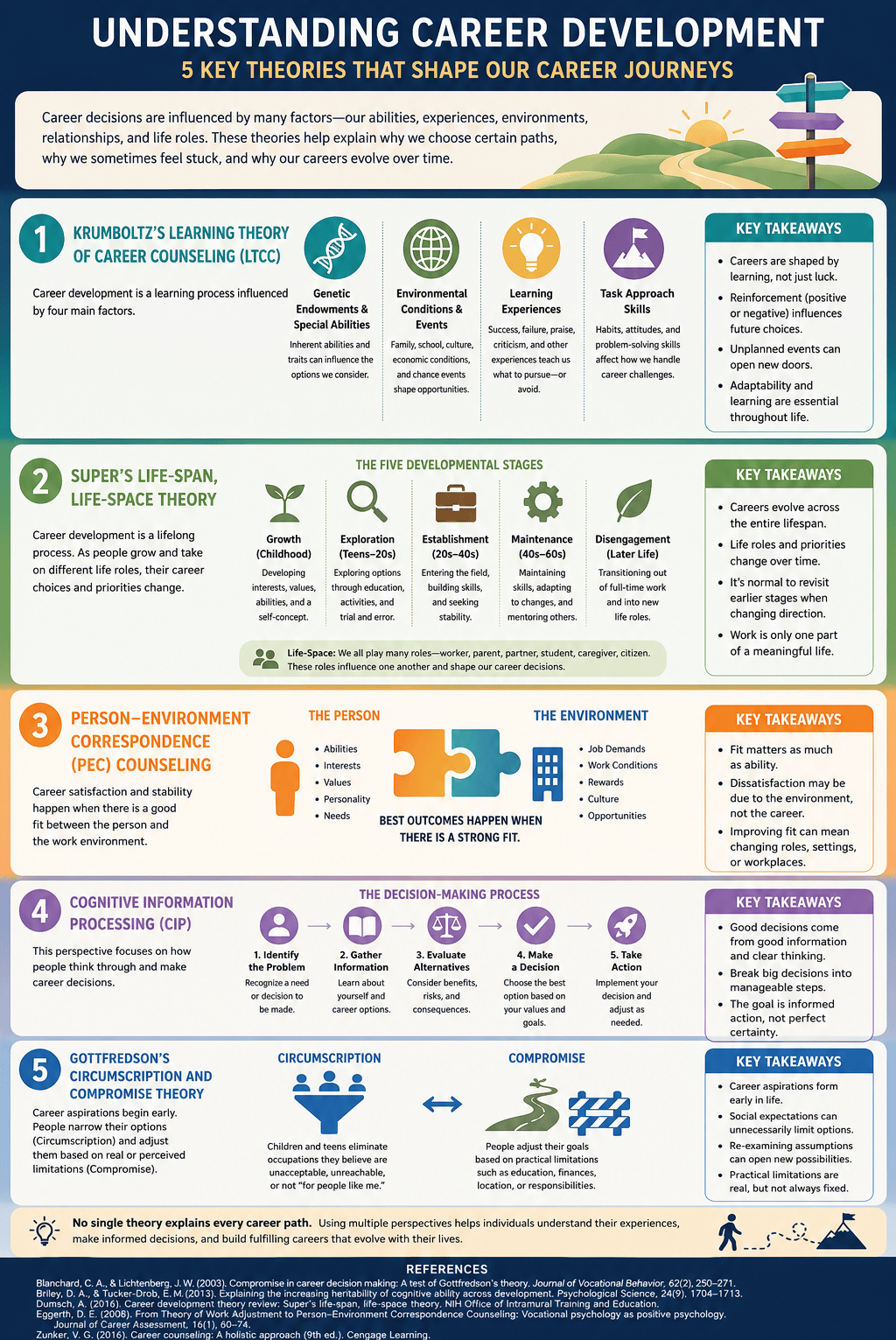
This article explores five influential approaches: Krumboltz’s Learning Theory of Career Counseling, Super’s Life-Span, Life-Space Theory, Person-Environment Correspondence Counseling, the Cognitive Information Processing perspective, and Gottfredson’s Circumscription and Compromise Theory.
Krumboltz’s Learning Theory of Career Counseling
Krumboltz’s Learning Theory of Career Counseling, or LTCC, proposes that career development is shaped by four primary factors: “(1) genetic endowments and special abilities, (2) environmental conditions and events, (3) learning experiences, and (4) task approach skills” (Zunker, 2016, p. 34).
Genetic Endowments and Special Abilities
The first factor includes characteristics and abilities that may influence the types of activities a person finds easier or more difficult. These may include physical characteristics, cognitive abilities, coordination, musical aptitude, or linguistic ability.
Genetic influences may contribute to differences in cognitive development. For example, Briley and Tucker-Drob (2013) found that “genes account for increasing proportions of variation in cognitive ability across development” (p. 1704). However, inherited abilities do not determine a person’s career. They operate alongside educational opportunities, relationships, socioeconomic conditions, personal effort, and cultural expectations.
A person with strong spatial reasoning may be encouraged toward engineering or architecture, while someone with advanced verbal abilities may receive praise in writing, law, education, or communication. These abilities can expand certain options, but the opportunities available to recognize and develop them remain important.
Environmental Conditions and Events
The second factor refers to circumstances outside the individual’s direct control. These may include family income, access to education, geographic location, discrimination, economic recessions, technological change, labor-market conditions, and exposure to particular occupations.
For example, a student who attends a well-funded school may have access to advanced science courses, internships, and career guidance. Another student with similar abilities may never encounter those opportunities. Likewise, a person who grows up around healthcare professionals may view medicine as a realistic option, while someone without that exposure may not consider it.
Unexpected events may also redirect a career. A company closure may force a worker to enter a new field, while a volunteer experience may reveal an interest that had never been explored. Krumboltz’s theory is especially helpful because it recognizes that unplanned events can become meaningful sources of career development rather than simply interruptions.
Learning Experiences
Learning experiences are central to Krumboltz’s theory. People develop beliefs about careers through direct experiences and through observing others. Success, praise, criticism, disappointment, and reinforcement may all influence future decisions.
Consider a student who receives repeated recognition for excelling in mathematics. Teachers and family members may encourage the student to pursue accounting or engineering. Over time, the student may conclude that this is the “correct” career direction. However, the student may be responding more strongly to praise and achievement than to a genuine interest in the work itself.
Negative experiences can be equally influential. An individual who works in a high-pressure corporate environment may learn that prestige and salary do not compensate for chronic stress. That experience may encourage the person to seek work that offers greater autonomy, balance, or meaning.
Krumboltz’s framework therefore helps distinguish between career choices based on intrinsic satisfaction and those maintained primarily through external reinforcement.
Task Approach Skills
Task approach skills include the habits, beliefs, emotional responses, and problem-solving strategies people use when confronting career-related challenges (Zunker, 2016). These may involve persistence, adaptability, planning, self-confidence, information gathering, and the ability to tolerate uncertainty.
Two people experiencing the same job loss may respond very differently. One may interpret the event as proof of personal failure and avoid applying for similar positions. Another may evaluate what happened, identify transferable skills, seek additional training, and pursue new opportunities. Their task approach skills influence how they interpret and respond to the same event.
Key Takeaways: Krumboltz’s Theory
Career paths develop through abilities, environments, experiences, and learned coping strategies.
Praise, success, criticism, and setbacks can reinforce particular career choices.
Unplanned events may create valuable new directions.
Career counseling can help people examine whether their choices reflect genuine interests or external reinforcement.
Adaptability and continued learning are central to career development.
Super’s Life-Span, Life-Space Theory
Donald Super’s framework presents career development as a lifelong process. Rather than treating career choice as a single decision, Super emphasizes that vocational identity continues to develop as people mature and move through different life roles.
Super’s model includes five major stages: growth, exploration, establishment, maintenance, and decline or disengagement (Dumsch, 2016). These stages are not necessarily rigid, and people may revisit earlier tasks when changing careers.
Growth
During the growth stage, children begin developing interests, abilities, values, and a general understanding of work. Early experiences with family, school, media, and community contribute to the formation of self-concept.
A child may begin to see themselves as creative, practical, caring, analytical, or mechanically inclined. These early perceptions may later shape the occupations they consider.
Exploration
During exploration, adolescents and young adults begin considering career possibilities, developing skills, and testing occupational preferences. This may occur through education, part-time employment, internships, volunteering, or conversations with people in different professions.
Exploration is not always complete by early adulthood. Individuals considering career changes may return to this stage as they investigate new fields and reconsider their identities.
Establishment
The establishment stage typically involves entering a field, developing competence, and attempting to create stability. Individuals may seek advancement, professional recognition, or increased responsibility.
However, establishment does not always mean remaining in one occupation. A person may discover that the field they selected does not fit their values or lifestyle and may begin another period of exploration.
Maintenance
During maintenance, individuals may focus on preserving their position, updating their skills, mentoring others, or remaining effective within a changing workplace. Some people experience satisfaction during this stage, while others begin questioning whether they want to continue in the same direction.
Disengagement
Disengagement involves reducing one’s involvement in paid employment and preparing for retirement or other life roles. This stage may include transferring knowledge, reducing hours, or developing identities outside work.
Super also emphasized “life-space,” which refers to the multiple roles an individual occupies. A person may simultaneously be a worker, partner, parent, student, caregiver, friend, and community member. These roles affect one another. A demanding job may conflict with caregiving responsibilities, while supportive relationships may make professional development possible.
Super’s framework is valuable because it recognizes that career satisfaction cannot be separated from the rest of life. A position that fits someone at age 25 may no longer fit at age 40 because their responsibilities, priorities, and self-concept have changed.
Key Takeaways: Super’s Theory
Career development continues throughout the lifespan.
People move through periods of growth, exploration, establishment, maintenance, and disengagement.
Career decisions reflect an evolving self-concept.
Work must be understood alongside other life roles.
Returning to an earlier stage, such as exploration, is a normal part of changing careers.
Person-Environment Correspondence Counseling
Person-Environment Correspondence, or PEC, Counseling developed from the Theory of Work Adjustment. This model focuses on the degree of fit between an individual and the work environment.
PEC proposes that career satisfaction and stability are more likely when a person’s abilities meet workplace demands and when the workplace provides the conditions and reinforcements the person values. Considerable research links person-environment congruence with job satisfaction (Walsh, 2003b, as cited in Eggerth, 2008).
For example, an individual may have the technical ability to succeed as a software developer but struggle in a workplace characterized by constant interruptions, competition, and unpredictable hours. The problem may not be the occupation itself. The problem may be the environment in which the work occurs.
Another person may value autonomy, creativity, and social contribution but work in a highly structured position with little decision-making authority. Even if the individual performs well, the environment may not provide the reinforcements necessary for satisfaction.
PEC also considers the workplace’s perspective. Employers require specific skills, reliability, productivity, and interpersonal behaviors. A sustainable match therefore depends on both the individual’s satisfaction and the organization’s satisfaction with the employee.
This model can be especially useful when someone assumes that dissatisfaction means they need an entirely new career. In some cases, changing employers, schedules, supervisors, or work settings may improve the fit without requiring a complete occupational change.
Key Takeaways: Person-Environment Correspondence
Career satisfaction depends partly on the fit between the person and the workplace.
Abilities should correspond with job demands.
The workplace should provide rewards and conditions that match the individual’s needs and values.
Dissatisfaction may reflect a poor environment rather than the wrong occupation.
Improving fit may involve changing roles, settings, expectations, or employers.
Cognitive Information Processing Perspective
The Cognitive Information Processing, or CIP, perspective focuses on how individuals think through career decisions. Rather than primarily explaining development across life stages, CIP addresses the knowledge and cognitive skills required to make informed choices.
Career decisions can become overwhelming when people have too much information, limited self-understanding, or negative beliefs about their options. Someone may repeatedly think, “I have to choose the perfect career,” “It is too late to start over,” or “Changing direction means I failed.” These beliefs can interfere with effective problem-solving.
CIP helps individuals examine three broad areas: knowledge of themselves, knowledge of occupational options, and the decision-making process. Self-knowledge may include interests, abilities, values, and lifestyle needs. Occupational knowledge includes information about training requirements, working conditions, salary, availability, and advancement.
The individual then learns to identify the problem, consider alternatives, evaluate consequences, make a choice, and take action. The goal is not to eliminate uncertainty, which is rarely possible, but to develop a reliable process for responding to it.
For example, a college graduate who feels paralyzed by several options may benefit from organizing the decision into manageable steps. Instead of asking, “What should I do with my entire life?” the person might compare two or three realistic options based on values, required training, financial considerations, and opportunities for experimentation.
Key Takeaways: Cognitive Information Processing
Career decision-making depends on self-knowledge and accurate occupational information.
Negative or rigid thoughts can interfere with effective choices.
Large decisions become more manageable when divided into structured steps.
The goal is not certainty, but informed and thoughtful action.
Decision-making skills can be learned and reused throughout life.
Gottfredson’s Circumscription and Compromise Theory
Gottfredson’s Circumscription and Compromise Theory focuses on how occupational aspirations begin forming during childhood. The theory proposes that children gradually eliminate occupations they perceive as unacceptable or incompatible with their developing self-concept.
Circumscription refers to narrowing the range of possibilities. Children and adolescents may reject occupations based on gender expectations, social class, prestige, perceived intelligence requirements, or beliefs about what people “like them” can realistically do. This creates a “zone of acceptable alternatives” (Gottfredson, 1981; Gottfredson, 1996, as cited in Blanchard & Lichtenberg, 2003).
For example, a child may decide that nursing is inappropriate for boys, that law is only for wealthy families, or that skilled trades lack sufficient prestige. These beliefs may develop long before the individual has accurate information about the work.
Compromise occurs when individuals adjust their aspirations in response to practical limitations, such as educational access, finances, geographic restrictions, family obligations, or limited job availability (Zunker, 2016). Compromise is not necessarily unhealthy; practical realities must be considered. However, people may compromise more than necessary when their decisions are based on inaccurate assumptions.
Career counseling may help individuals identify occupations they eliminated prematurely. Revisiting those assumptions can expand the range of options and reveal paths that are both realistic and personally meaningful.
Key Takeaways: Gottfredson’s Theory
Career options begin narrowing during childhood and adolescence.
Gender roles, social class, prestige, and perceived accessibility shape aspirations.
People may reject careers before learning what those careers actually involve.
Compromise reflects adjustments made in response to real or perceived limitations.
Career counseling can help individuals reconsider options that were prematurely excluded.
Integrating the Models
Each theory highlights a different part of career development. Krumboltz emphasizes learning, reinforcement, and adaptation. Super focuses on development across the lifespan and the interaction of life roles. PEC examines the match between the individual and the workplace. CIP addresses the thinking and problem-solving skills involved in making decisions. Gottfredson explains how social expectations narrow occupational possibilities from an early age.
These models are not mutually exclusive. A person experiencing burnout may have learned to value achievement through reinforcement, as Krumboltz might suggest. They may also be entering a new developmental stage described by Super, experiencing a poor workplace fit explained by PEC, struggling with negative thinking addressed by CIP, and reconsidering occupations they previously excluded through circumscription.
Using multiple perspectives provides a more complete understanding of the person’s experience.
Conclusion
Career development is not simply the process of selecting an occupation. It is an evolving interaction between identity, learning, opportunity, environment, relationships, and social context.
These theories help normalize uncertainty and change. A career transition does not necessarily mean that a previous decision was wrong. It may reflect new learning, changing life roles, increased self-awareness, or a desire for a better fit.
By understanding the influences behind career choices, individuals can move beyond the pressure to discover one perfect profession. Instead, they can make thoughtful decisions that better reflect their abilities, values, circumstances, and current stage of life.
References
Blanchard, C. A., & Lichtenberg, J. W. (2003). Compromise in career decision making: A test of Gottfredson’s theory. Journal of Vocational Behavior, 62(2), 250–271. https://doi.org/10.1016/S0001-8791(02)00026-X
Briley, D. A., & Tucker-Drob, E. M. (2013). Explaining the increasing heritability of cognitive ability across development. Psychological Science, 24(9), 1704–1713. https://doi.org/10.1177/0956797613478618
Dumsch, A. (2016, January 25). Career development theory review: Super’s life-span, life-space theory. OITE Career Blog—NIH Office of Intramural Training and Education. https://oitecareersblog.od.nih.gov/2016/01/25/career-development-theory-review-supers-life-span-life-space-theory
Eggerth, D. E. (2008). From Theory of Work Adjustment to Person–Environment Correspondence Counseling: Vocational psychology as positive psychology. Journal of Career Assessment, 16(1), 60–74. https://doi.org/10.1177/1069072707305771
Zunker, V. G. (2016). Career counseling: A holistic approach (9th ed.). Cengage Learning.
Ryan Shannon, LMHCA, MA, MS
ryan@brainhealtherapy.com
Virtual Therapy in Washington State
© 2026 Ryan Shannon-Evidence-based therapy and EMDR in Washington State. Disclaimer: The information provided on this website is for educational and informational purposes only and is not intended as medical, psychological, or mental health advice. Viewing this website or contacting me through this site does not establish a therapist-client relationship. A therapeutic relationship is formed only after we have completed an initial consultation, mutually agreed to work together, and all required intake paperwork has been completed.
While I strive to keep the information on this website accurate and up to date, I make no guarantees regarding its completeness, accuracy, or applicability to your individual circumstances. You should not rely on the information on this website as a substitute for professional mental health, medical, or legal advice. I am not responsible for any actions taken based on the information provided on this website.
If you are experiencing a mental health emergency or are in immediate danger, call 911 or go to your nearest emergency room. You can also call or text 988 to reach the Suicide & Crisis Lifeline.