
Men are often expected to remain composed, independent, productive, and capable, even when they are struggling internally. You may be accustomed to solving problems on your own, pushing through discomfort, or focusing on work and responsibilities rather than what you are feeling.
These qualities can be strengths. However, self-reliance can become isolating when it leaves little room to process trauma, acknowledge emotional needs, or ask for support.
Online Therapy for Men in Washington State


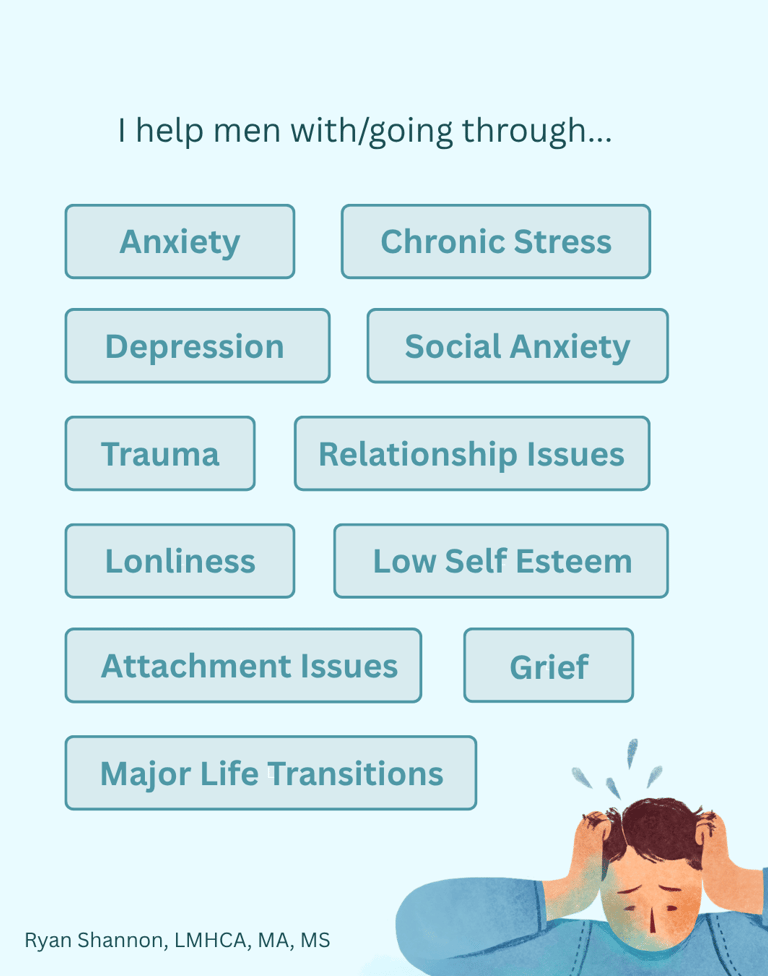
I provide online therapy for men throughout Washington State, offering compassionate, personalized, and evidence-based mental health care through secure video sessions. I work with men experiencing:
anxiety,
depression,
trauma,
chronic stress,
relationship problems,
social anxiety,
low self-esteem,
loneliness,
attachment difficulties,
grief,
and major life transitions.
My approach is practical, collaborative, and adapted to the individual. Therapy does not require you to reject masculinity, speak about emotions in a particular way, or become someone you are not. Instead, it can help you better understand yourself, develop useful tools, process experiences that continue to affect you, and move toward a life that feels more balanced and meaningful.
Secure virtual therapy is available to adults located throughout Washington State.
Schedule Session
For the fastest response, please use this contact form or email as I may be busy and unable to answer the phone. I'll get back to you soon.
Phone
707-727-8727
ryan@brainhealtherapy.com


Men’s Mental Health Deserves Attention
Mental health concerns can affect people of every gender, but men may face particular barriers to receiving support. Research suggests that men are less likely than women to seek help for psychological concerns, and some men report difficulty finding mental health services that feel welcoming or relevant to them (Liddon et al., 2018).
Messages about masculinity frequently begin early:
Stay strong.
Do not complain.
Remain in control.
Handle problems independently.
Succeed at work.
Provide for others.
Avoid appearing vulnerable.
These expectations may make it difficult to recognize distress until it begins affecting work, sleep, health, relationships, or daily functioning. Some men wait until a relationship is ending, anger feels uncontrollable, work becomes unsustainable, or emotional numbness turns into hopelessness.
The consequences can be serious. In 2024, the age-adjusted suicide rate among males in the United States was nearly four times the rate among females.
This does not mean men are inherently unwilling or unable to benefit from therapy. It means therapy should be respectful of the ways men have learned to understand themselves, communicate distress, and seek solutions. The American Psychological Association encourages clinicians to help men examine restrictive expectations while developing personally meaningful and healthy ways of understanding masculinity.
Reasons Men Begin Therapy
You do not need to be in crisis to benefit from counseling. Men contact me for many different reasons, including:
Persistent anxiety or overthinking
Depression, low motivation, or hopelessness
Irritability, anger, or feeling constantly on edge
Chronic work stress and burnout
Pressure to perform, succeed, or provide
PTSD and trauma-related symptoms
Painful childhood experiences
Relationship conflict or repeated relationship patterns
Anxious or avoidant attachment
Fear of rejection or abandonment
Difficulty trusting or becoming emotionally close
Social anxiety and self-consciousness
Loneliness or lack of meaningful friendships
Low self-esteem and insecurity
Perfectionism
Grief and loss
Difficulty identifying or expressing emotions
Major career, relationship, or identity transitions
Feeling successful externally but unfulfilled internally
Wanting to understand themselves more deeply
Some men know precisely what they want to address. Others simply recognize that something feels wrong: they are more reactive, disconnected, tired, anxious, or unhappy than they want to be.
Therapy can provide a place to make sense of what is happening before determining what needs to change.
How I Help Men in Therapy
A Practical and Structured Approach
Therapy does not have to consist of speaking without direction while the therapist silently listens.
Many men appreciate knowing what they are working toward and how therapy may help. Research on engaging men in psychological treatment has identified the potential value of clearly structured, goal-oriented, action-focused, and progress-driven communication, while recognizing that no single approach fits every man (Seidler et al., 2018).
We May Begin by Identifying:
What is currently causing distress
How the problem affects your relationships, work, health, or daily life
Patterns that may be maintaining the problem
What you want to be different
Which skills or therapeutic approaches may help
How we will recognize progress
Our goals can evolve as you gain insight. Structure provides direction without making therapy rigid or impersonal.
Emotional understanding without pressure
Some men have spent years intellectualizing their feelings, minimizing painful experiences, or converting vulnerable emotions into anger, problem-solving, humor, work, or withdrawal.
You may understand your situation logically but still feel unable to change how you react. You may know that a fear is irrational while continuing to experience it physically. You may also find that “I’m stressed” is the only available description for a much more complicated internal experience.
Therapy Can Help You Gradually:
Recognize emotional and physical cues
Identify what triggers anger, anxiety, or shutdown
Understand what may exist beneath irritability
Connect present reactions with earlier experiences
Put feelings into language without becoming overwhelmed
Communicate needs more directly
Respond intentionally rather than react automatically
You will not be forced to disclose more than you are ready to discuss. Emotional awareness is a skill that can be developed, not a test you can fail.
Building on Healthy Masculine Strengths
Therapy for men should not assume that masculinity is a problem.
Qualities commonly associated with masculinity, such as courage, responsibility, persistence, protection, humor, leadership, loyalty, discipline, and the desire to contribute, can become valuable resources in therapy.
The Positive Masculinity model emphasizes identifying and building upon men’s existing strengths rather than viewing masculinity only through a lens of dysfunction (Kiselica & Englar-Carlson, 2010).
At the same time, we can examine whether particular expectations are working against you. For example:
Does independence prevent you from accepting support?
Does ambition make rest feel unacceptable?
Does responsibility lead you to neglect your own needs?
Does emotional control turn into emotional avoidance?
Does protectiveness make vulnerability feel unsafe?
Does fear of appearing weak prevent honest communication?
You get to decide what being a man means to you. Therapy can help you retain the values and qualities that serve you while loosening expectations that contribute to shame, isolation, or distress.
Anxiety, Chronic Stress, and Burnout in Men
Anxiety does not always appear as obvious fear. It may look like:
Constant planning or problem-solving
Difficulty relaxing
Replaying conversations
Irritability
Muscle tension
Trouble sleeping
Perfectionism
Overworking
Fear of disappointing others
Avoiding situations where you may be judged
Feeling responsible for preventing every possible problem
Some men function well externally while remaining chronically activated internally. You may continue meeting expectations while feeling increasingly exhausted, detached, or unable to enjoy your life.
In therapy, I can help you identify the thoughts, experiences, and behavioral patterns maintaining anxiety. Depending on your needs, we may use cognitive restructuring, mindfulness, exposure, EMDR, somatic awareness, problem-solving, or acceptance-based strategies.
The goal is not to eliminate every difficult emotion. It is to help you respond to stress with greater flexibility, confidence, and control.
Depression, Irritability, and Emotional Numbness
Depression in men may involve sadness, but it can also appear through:
Irritability or anger
Emotional numbness
Loss of interest
Withdrawal from friends or partners
Low energy
Difficulty concentrating
Feeling unsuccessful or inadequate
Working excessively to avoid thinking
Increased alcohol or substance use
Recklessness
Sleep or appetite changes
Feeling disconnected from purpose
Believing others would be better off without you
Men may dismiss these experiences as stress, weakness, laziness, or a personal failure. Therapy can help distinguish between temporary discouragement and patterns that may require closer attention.
Our work may focus on rebuilding daily structure, examining self-critical beliefs, reconnecting with meaningful activities, improving emotional awareness, processing painful experiences, strengthening relationships, and developing a more sustainable sense of self-worth.
Trauma, PTSD, and Painful Childhood Experiences
Trauma is not limited to military combat, assault, or catastrophic events. Men may also be affected by experiences they have learned to minimize, including:
Emotional or physical neglect
Bullying
Family instability
Harsh or unpredictable parenting
Witnessing violence
The death or suicide of someone close
Rejection related to sexual orientation
Relationship betrayal
Medical trauma
Workplace trauma
Humiliation
Being expected to “toughen up” before feeling safe
Having emotions mocked or punished repeatedly or severely
Time does not always resolve these experiences. Unprocessed trauma may continue to appear through anxiety, emotional activation, intrusive thoughts, anger, avoidance, distrust, shame, relationship difficulties, or feeling unsafe even when the original danger has passed.
EMDR therapy
Eye Movement Desensitization and Reprocessing, or EMDR, is a trauma-focused psychotherapy used to help people process distressing memories and reduce the intensity of trauma-related reactions. EMDR is among the trauma-focused psychotherapies recommended for PTSD in major clinical guidelines.
When appropriate, EMDR may help you revisit painful experiences in a structured way so that those memories feel less immediate, emotionally charged, or controlling.
Cognitive Processing Therapy
Cognitive Processing Therapy, or CPT, helps people identify and evaluate trauma-related beliefs about safety, trust, control, self-esteem, responsibility, and intimacy.
Traumatic or humiliating experiences may lead to beliefs such as:
“It was my fault.”
“I should have prevented it.”
“I cannot trust anyone.”
“I always need to be in control.”
“Something is wrong with me.”
“The world is never safe.”
CPT teaches clients to examine whether these conclusions are accurate, complete, or helpful. The National Center for PTSD describes CPT as a highly researched, trauma-focused treatment for PTSD.
Attachment, Relationships, and Intimacy
You may want closeness while feeling uncomfortable depending on another person. You might become anxious when a partner pulls away, or you may feel overwhelmed when someone wants greater emotional intimacy.
Attachment patterns can affect:
Trust
Dating
Jealousy
Reassurance-seeking
Fear of abandonment
Emotional withdrawal
Conflict
Communication
Sexual and emotional intimacy
The ability to ask for support
Men with anxious attachment may overanalyze messages, worry about rejection, or need frequent confirmation that a relationship is secure. Men with avoidant patterns may value relationships while distancing themselves when intimacy feels threatening.
Therapy can help you understand how these patterns developed, recognize what activates them, communicate more effectively, and build relationships based on greater security rather than fear or avoidance.
Social Anxiety, Confidence, and Male Loneliness
You may appear competent while privately worrying that others see you as awkward, boring, weak, unattractive, or unsuccessful.
Social anxiety can involve:
Rehearsing conversations
Avoiding dating or social events
Overanalyzing what you said
Assuming others judged you negatively
Difficulty initiating friendships
Fear of appearing nervous
Comparing yourself with other men
Feeling alone despite knowing many people
Men may have friends, coworkers, partners, or family members without having anyone with whom they feel comfortable speaking honestly. Research has linked male loneliness with significant psychological risks, while social support is broadly associated with better mental health (Fasihi Harandi et al., 2017; Mansour et al., 2021).
I may use graded exposure, role-play, cognitive reframing, mindfulness, EMDR, communication practice, and behavioral experiments to help you feel more comfortable in social situations and build meaningful connections.
Work, Performance, and Provider Pressure
For many men, work becomes closely connected to identity and self-worth.
You may feel that you must:
Earn more
Advance quickly
Remain productive
Support your family
Never appear uncertain
Solve everyone’s problems
Continue performing despite exhaustion
Career ambition can be healthy. However, it can become painful when success feels like the only acceptable outcome or when your value depends entirely on your performance.
My background includes a Master of Science in Work and Organizational Psychology, which informs my understanding of motivation, workplace behavior, career identity, burnout, leadership pressure, and organizational stress.
I work with professionals, including technology workers, executives, healthcare professionals, helping professionals, veterans, gifted adults, and men navigating significant career changes.
Therapy can help you pursue meaningful goals without sacrificing your health, relationships, or sense of identity outside work.
Therapy for Gay and Bisexual Men
Gay and bisexual men may experience many of the same concerns as other men while also navigating additional pressures related to identity, belonging, rejection, family, dating, body image, safety, religion, community expectations, or minority stress.
You may have learned to monitor how you speak, move, dress, or express emotion. You may feel caught between traditional expectations of masculinity and expectations within LGBTQ+ communities.
I offer affirming therapy for gay, bisexual, straight, questioning, and other men throughout Washington. You will not be expected to express masculinity, sexuality, relationships, or identity in any prescribed way.
Our work can address the concerns bringing you to therapy while respecting the cultural and personal experiences that have shaped you.
Therapeutic Approaches I May Use
Therapy is individualized rather than based on a single modality. Depending on your needs, goals, readiness, and preferences, I may integrate:
Eye Movement Desensitization and Reprocessing Therapy
Cognitive Processing Therapy
Cognitive Behavioral Therapy
Acceptance and Commitment Therapy
Attachment-based therapy
Adlerian therapy
Dialectical Behavior Therapy skills
Motivational Interviewing
Mindfulness-based interventions
Person-centered therapy
Psychodynamic concepts
Solution-Focused Brief Therapy
Somatic awareness
Trauma-informed care
EMDR and CPT are among the trauma-focused psychotherapies recommended for PTSD. Other approaches may be used to address anxiety, depression, relationships, behavior patterns, emotional regulation, self-esteem, and personal growth.
We can discuss which methods make the most sense for you during your consultation and initial sessions.
Free 15-Minute Consultation
I offer a complimentary 15-minute consultation to discuss how I can help you and to see if you feel at ease with me. I'm here to address any questions you might have.
What Online Therapy With Me Is Like
1. We clarify what is happening
We begin by discussing what led you to therapy, how long the problem has been present, and how it affects your life.
2. We identify meaningful goals
Your goals may involve reducing anxiety, processing trauma, improving a relationship, becoming more confident, controlling anger, sleeping better, or feeling more connected to your life.
3. We understand the patterns
We examine the thoughts, emotions, physical reactions, past experiences, relationship dynamics, and coping strategies connected to the problem.
4. We develop and practice new tools
Depending on your needs, this may involve coping strategies, cognitive work, communication skills, behavioral changes, mindfulness, exposure, emotional regulation, EMDR, or trauma processing.
5. We evaluate progress
We regularly consider what is helping, what remains difficult, and whether our approach needs to change.
Therapy is collaborative. I bring clinical training and perspective, while you bring knowledge of your history, priorities, strengths, and lived experience.
Online Counseling Across Washington State
I provide secure online counseling through HIPAA-compliant video to adults located throughout Washington State.
Virtual therapy may be especially helpful when you:
Have a demanding or unpredictable schedule
Prefer the privacy of attending from home
Live in an area with limited local therapy options
Want to avoid commuting
Travel frequently within Washington
Feel more comfortable beginning therapy virtually
Are specifically seeking a therapist who works with men, trauma, attachment, or EMDR
I work virtually with clients in Seattle, Bellevue, Tacoma, Olympia, Everett, Spokane, Vancouver, Bellingham, Yakima, the Tri-Cities, and communities throughout Washington.
Washington permits appropriately credentialed practitioners to provide telehealth services within their scope of practice and applicable professional standards.
Clients must be physically located in Washington State at the time of each therapy session.
About Ryan Shannon, LMHCA, MS, MA
I am a Licensed Mental Health Counselor Associate providing online therapy throughout Washington State.
I earned my Master of Arts in Clinical Mental Health Counseling from Marshall University, graduating with a 4.0 GPA. I also hold a Master of Science in Work and Organizational Psychology from the University of Seville.
My training and clinical interests include trauma, EMDR, Cognitive Processing Therapy, anxiety, depression, attachment, relationships, mindfulness, psychological assessment, and men’s mental health.
Before becoming a therapist, I worked in marketing and gained experience administering psychological assessments in hospital and outpatient settings. These experiences strengthened my understanding of human behavior, motivation, cognition, and the ways emotional concerns can affect work, relationships, and daily functioning.
My therapeutic style is compassionate, thoughtful, practical, and evidence-informed. As a Vipassana meditation practitioner, I also value present-moment awareness and helping clients develop a healthier relationship with their thoughts and emotions.
I welcome straight, gay, bisexual, questioning, and other men from varied cultural, professional, religious, and personal backgrounds. There is no single correct way to be a man, and therapy should make room for the person you are rather than forcing you into another set of expectations.
I am licensed as a Mental Health Counselor Associate in Washington State under credential number MHCA.MC.70082181 and receive clinical supervision.
Frequently Asked Questions
Do I need to be comfortable talking about emotions?
No. Many men begin therapy without knowing how to explain what they are feeling. We can start with what you notice: thoughts, behaviors, physical tension, relationship patterns, sleep, irritability, or situations that repeatedly create problems.
Emotional awareness can develop gradually.
Is therapy just talking about childhood?
No. Childhood may be relevant when earlier experiences continue to affect your present reactions, relationships, or beliefs. However, therapy can also be highly focused on current problems, practical skills, specific goals, and future changes.
What if I tend to intellectualize my feelings?
Intellectualization can be a useful way of organizing complex experiences, but it may become limiting when you understand everything logically while continuing to feel stuck.
I can help you use your analytical strengths while also noticing physical, emotional, and behavioral information that logic alone may not resolve.
Can therapy help with anger?
Yes. Anger may be connected to stress, trauma, fear, humiliation, grief, relationship patterns, unmet needs, or difficulty expressing more vulnerable emotions.
Therapy can help you understand the purpose of anger, recognize early warning signs, communicate more effectively, and respond without causing harm to yourself or others.
Is online therapy effective for trauma?
Many trauma-focused interventions can be provided through telehealth when clinically appropriate. We will consider your symptoms, privacy, stability, safety, preferences, and ability to participate from a suitable environment before deciding whether online trauma work is appropriate.
Do you work only with men?
No. I provide therapy to adults of different genders. Men’s mental health is one of my areas of clinical interest, and this page explains how I adapt therapy to concerns that frequently affect men.
Do you work with gay and bisexual men?
Yes. I provide affirming therapy to gay, bisexual, straight, questioning, and other men. Sexual orientation can be part of therapy when it is relevant, but it does not need to become the focus of every session.
Where do I need to be during sessions?
You must be physically located in Washington State during each session. You will also need a private location and a reliable internet connection.
How do I know whether you are the right therapist for me?
I offer a complimentary 15-minute consultation so that you can ask questions, briefly describe what you want help with, and determine whether you feel comfortable speaking with me.
Begin Online Therapy for Men in Washington
You do not have to wait until the problem becomes a crisis.
Whether you are struggling with anxiety, depression, trauma, attachment concerns, relationship difficulties, loneliness, chronic stress, or a major change, therapy can help you understand what is happening and begin responding differently.
I offer secure online counseling for adults throughout Washington State. Contact me to schedule a complimentary 15-minute consultation and discuss whether my approach may be a good fit for you.
Ryan Shannon, LMHCA, MS, MA
Online Mental Health Therapy in Washington State
ryan@brainhealtherapy.com
Free 15-Minute Consultation
Crisis Support
This practice does not provide emergency or crisis services through the website, email, or consultation form. If you are in immediate danger or experiencing a mental health emergency, call 911 or go to the nearest emergency room. You may also call or text 988 to reach the Suicide & Crisis Lifeline. The 988 Lifeline also provides online chat support.
References
American Psychological Association. (2018). APA guidelines for psychological practice with boys and men.
Centers for Disease Control and Prevention. (2026). Suicide data and statistics.
Fasihi Harandi, T., Mohammad Taghinasab, M., & Dehghan Nayeri, T. (2017). The correlation of social support with mental health: A meta-analysis. Electronic Physician, 9(9), 5212–5222.
Kiselica, M. S., & Englar-Carlson, M. (2010). Identifying, affirming, and building upon male strengths: The positive psychology/positive masculinity model of psychotherapy with boys and men. Psychotherapy: Theory, Research, Practice, Training, 47(3), 276–287.
Liddon, L., Kingerlee, R., & Barry, J. A. (2018). Gender differences in preferences for psychological treatment, coping strategies, and triggers to help-seeking. British Journal of Clinical Psychology, 57(1), 42–58.
Mansour, K. A., Greenwood, C. J., Biden, E. J., Francis, L. M., Olsson, C. A., & Macdonald, J. A. (2021). Pre-pandemic predictors of loneliness in adult men during COVID-19. Frontiers in Psychiatry, 12.
National Center for PTSD. (2026). Cognitive Processing Therapy for PTSD.
National Center for PTSD. (2026). Eye Movement Desensitization and Reprocessing for PTSD.
Seidler, Z. E., Rice, S. M., Ogrodniczuk, J. S., Oliffe, J. L., & Dhillon, H. M. (2018). Engaging men in psychological treatment: A scoping review. American Journal of Men’s Health, 12(6), 1882–1900.
Seidler, Z. E., Wilson, M. J., Kealy, D., Oliffe, J. L., Ogrodniczuk, J. S., & Rice, S. M. (2021). Men’s dropout from mental health services: Results from a survey of Australian men across the life span. American Journal of Men’s Health, 15(3).
Washington State Department of Health. (2026). Telehealth resources.
Ryan Shannon, LMHCA, MA, MS
ryan@brainhealtherapy.com
Virtual Therapy in Washington State
© 2026 Ryan Shannon-Evidence-based therapy and EMDR in Washington State. Disclaimer: The information provided on this website is for educational and informational purposes only and is not intended as medical, psychological, or mental health advice. Viewing this website or contacting me through this site does not establish a therapist-client relationship. A therapeutic relationship is formed only after we have completed an initial consultation, mutually agreed to work together, and all required intake paperwork has been completed.
While I strive to keep the information on this website accurate and up to date, I make no guarantees regarding its completeness, accuracy, or applicability to your individual circumstances. You should not rely on the information on this website as a substitute for professional mental health, medical, or legal advice. I am not responsible for any actions taken based on the information provided on this website.
If you are experiencing a mental health emergency or are in immediate danger, call 911 or go to your nearest emergency room. You can also call or text 988 to reach the Suicide & Crisis Lifeline.